


Have you ever felt out of breath after climbing a few stairs? Maybe you checked your finger at home with a small clip and saw a number that worried you. You are not alone. Many people now ask the same question: how to improve oxygen level at home?
The good news is that you can do simple, safe things at home to help your body get and use oxygen better. You can breathe in a smarter way, sit or lie in better positions, keep your air clean, drink enough water, eat well, and stay a little active. These small steps can help you feel calmer, lighter, and stronger.
But there is also something very important to know. Home tips are not a cure for a real lung or heart problem. If your oxygen level is truly low, you need a doctor, and sometimes you need medical oxygen. In this guide, we will explain everything in easy words. You will learn what oxygen level means, what numbers are normal, how to check at home, 15 helpful tips, and the clear signs that tell you it is time to get help.
Let us start with the basics.
What Does “Oxygen Level” Mean?
When people say “oxygen level,” they usually mean the amount of oxygen in their blood. Doctors call this oxygen saturation, or SpO2.
Here is how it works in a simple way. You breathe air into your lungs. In your lungs, oxygen moves into your blood. Your blood has tiny parts called red blood cells. Inside them is a protein called hemoglobin. Hemoglobin picks up oxygen like a small bus picking up passengers. Then your heart pumps this blood to your brain, muscles, and every other part of your body.
SpO2 tells you what percent of those “bus seats” are filled with oxygen. If your SpO2 is 97%, it means 97 out of every 100 seats are full. That is great.
Your body needs steady oxygen all day and all night. It helps your brain think, your heart beat, your muscles move, and your body heal. When oxygen runs low, you may feel tired, dizzy, confused, or short of breath.
What Is a Normal Oxygen Level?
For most healthy people, a normal blood oxygen level is 95% to 100%. Your number may change a little through the day. It can be a bit lower when you sleep and a bit different when you exercise.
Here is an easy chart to remember:
| SpO2 Reading | What It Usually Means |
|---|---|
| 95% to 100% | Normal for most healthy people |
| 92% to 94% | A little low. Rest, breathe slowly, and check again. Watch your symptoms. |
| 91% or below | Low. Talk to a doctor soon. |
| 90% or below with trouble breathing | Get medical help right away. |
A few important notes:
- Some people with long-term lung problems, such as COPD, may have a lower normal number. Their doctor may set a target range just for them. If you have a lung disease, follow your own doctor’s plan.
- People who live at high places, like mountain towns, may also have slightly lower readings because the air has less oxygen.
- The number alone does not tell the full story. How you feel matters too. If you feel very short of breath, confused, or have chest pain, do not wait for a number. Get help.
How to Check Your Oxygen Level at Home
The easiest tool is a pulse oximeter. It is a small clip that goes on your finger. It shines a light through your skin and reads how much oxygen your blood is carrying. You can buy one at a medical store or online.
To get a good reading, follow these steps:
- Sit down and rest for about five minutes before you check.
- Warm your hands: Cold fingers can give a wrong number.
- Remove nail polish or fake nails from the finger you use. Dark polish can block the light.
- Keep your hand still and rest it on your chest or on a table, at about heart level.
- Clip it on your middle or index finger and wait about 30 to 60 seconds, until the number stops changing.
- Write the number down with the time and how you feel.
A small warning: home oximeters are helpful, but they are not perfect. They can be off by a few points. Some studies have found they may read higher than the true number in people with darker skin. Cold hands, shaky hands, and poor blood flow can also cause errors. So never trust one single reading. Look at the trend over time and always pay attention to your body.
Two Different Things: Oxygen in Your Blood vs. Oxygen in Your Room
When people search for how to improve oxygen level at home, they mean one of two things. It helps to know the difference.
1. Oxygen in your blood: This is your SpO2. You can support it with better breathing, good posture, light movement, healthy habits, and treating any health problem behind it.
2. Oxygen in the air of your home: The air around you already has about 21% oxygen, whether you are in a house, a park, or a city. You cannot raise this much with plants, salt lamps, or candles. What you can do is keep the air fresh and clean, so your lungs have an easier job.
This guide covers both. First, let us look at the tips that help your body. Then, we will see how to make the air in your home better.
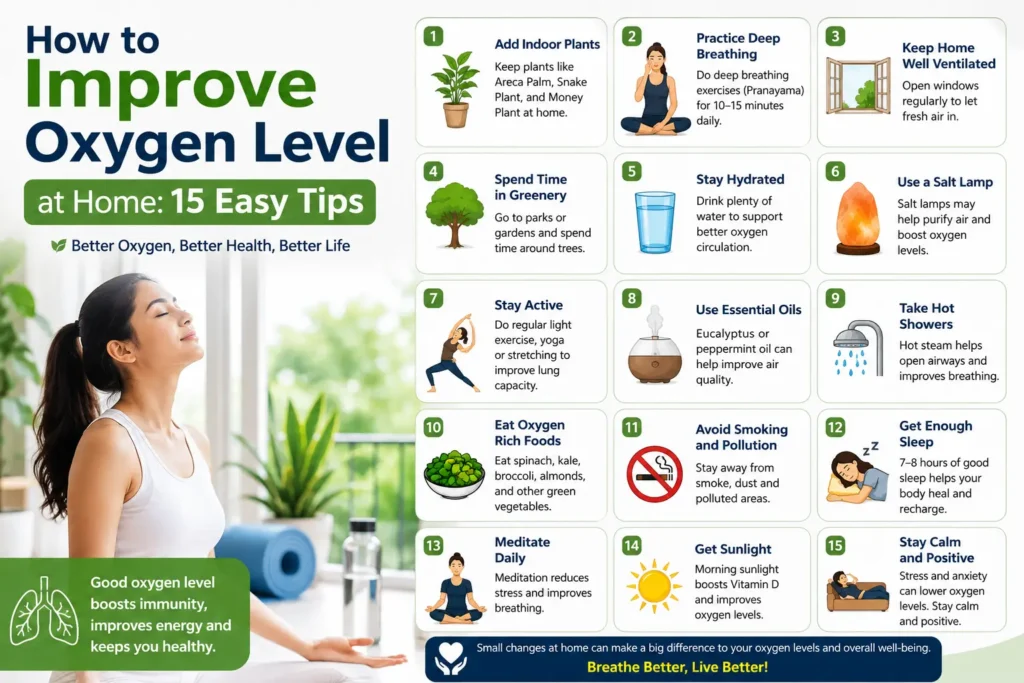
Part 1: 11 Easy Ways to Support Your Blood Oxygen Level at Home
Tip 1: Get Fresh Air
This is the simplest tip of all. Open your windows and doors for a few minutes each day so fresh air can come in. Stale air inside a closed room can feel heavy, and it may hold dust, smoke, and extra carbon dioxide from everyone breathing.
If the air outside is clean, sit near an open window, on a balcony, or in a garden for a while. If the air outside is smoky or very polluted, skip this and use a good air purifier inside instead. Fresh air will not magically fix a medical problem, but it helps your lungs work in a clean, calm space.
Tip 2: Practice Deep Belly Breathing
Most of us breathe in a short, shallow way, mostly using the top of the chest. Deep belly breathing, also called diaphragmatic breathing, uses the big muscle under your lungs. This helps your lungs fill better and can help air reach the lower parts of your lungs, where much of the oxygen exchange happens.
Here is how to do it:
- Sit in a chair or lie on your back with your knees bent.
- Place one hand on your chest and one on your belly.
- Breathe in slowly through your nose for about 4 seconds. Let your belly rise like a balloon. Your chest hand should move very little.
- Breathe out slowly through your mouth or nose for about 6 seconds. Feel your belly go down.
- Repeat for 5 to 10 minutes, two to three times a day.
Go slow and stay gentle. If you feel dizzy, stop and breathe normally. Over time, this habit can also lower stress and help you feel more relaxed.
Tip 3: Try Pursed-Lip Breathing
This is a favorite trick for people who get short of breath. It helps keep your airways open a little longer, so old air can leave your lungs and make room for new air.
Here is how:
- Relax your neck and shoulders.
- Breathe in slowly through your nose for about 2 seconds.
- Pucker your lips as if you are going to blow out a candle or whistle.
- Breathe out slowly through your lips for about 4 seconds. The out-breath should take about twice as long as the in-breath.
- Repeat until you feel calmer.
You can use this when you climb stairs, walk, or feel breathless. It is safe for most people and easy to learn.
Tip 4: Sit Up and Keep Good Posture
How you sit or stand changes how well your lungs can open. When you slouch, your chest gets squeezed and your lungs cannot expand fully. When you sit tall, your ribs and belly have more room.
Try these small changes:
- Sit with your back straight and your shoulders relaxed.
- Keep your feet flat on the floor.
- Do not lie flat for a long time if breathing feels hard. Use two or three pillows to raise your head and chest.
- If you work on a laptop, raise the screen so you are not bending your neck all day.
You may notice that you breathe more easily just by sitting better.
Tip 5: Try Safe Lying Positions
Some positions help air reach different parts of your lungs. One common example is prone positioning, which simply means lying on your stomach. Doctors have used this in hospitals for some patients, and some people use pillows to try it at home when they feel stable.
If you want to try it:
- Lie on your stomach with a pillow under your chest and another under your legs.
- Or lie on your side with pillows for support.
- Change positions every 30 minutes to two hours, based on comfort.
- Do not use this position right after a big meal.
This tip is not for everyone. Do not try it if you are pregnant, have a heart problem, have back or neck pain, or have severe breathing trouble, unless your doctor says it is fine. And remember: if your oxygen stays low, changing position is not enough. Call a doctor.
Tip 6: Do Gentle Exercise
Moving your body helps your lungs and heart work better. Over time, regular exercise makes your body better at using the oxygen it gets.
Good choices include:
- Slow walking in the house or outside
- Light stretching or gentle yoga
- Cycling at an easy pace
- Swimming, if you have a safe place and your doctor agrees
Start small. Even 10 minutes a day is a good start. Add a few minutes each week. You should be able to talk while you move. If you cannot speak in short sentences, slow down.
If you are recovering from an illness, have a lung or heart condition, or feel weak, ask your doctor before you start. Some people may need a special program called pulmonary rehabilitation, which teaches safe exercise and breathing step by step.
Tip 7: Drink Enough Water
Water helps keep the thin lining inside your lungs and airways moist. When you are well hydrated, mucus stays thinner and is easier to cough out. Your blood also flows better, so it can carry oxygen to your body more easily.
There is no special drink that raises your oxygen level. Plain water is best. Most adults do well with around 6 to 8 glasses a day, but this can change with weather, activity, and health. If you have a heart or kidney problem, ask your doctor how much fluid is right for you.
Tip 8: Eat Foods That Help Your Blood and Lungs
No food can raise your oxygen number right away. But good food keeps your blood, heart, and lungs healthy over time. That helps your body carry and use oxygen well.
Here is what to add to your plate:
- Iron-rich foods such as lentils, beans, spinach, tofu, eggs, and lean meat. Iron helps make hemoglobin, the part of the blood that carries oxygen. Low iron, called anemia, can make you feel breathless even when your SpO2 is normal.
- Vitamin C foods such as oranges, lemons, guava, strawberries, and bell peppers. Vitamin C helps your body take in iron from plant foods.
- Fruits and vegetables with color, such as carrots, tomatoes, beets, and berries. They have antioxidants that help protect your body.
- Healthy fats such as walnuts, flaxseed, and fatty fish like salmon. These are good for the heart.
- Whole grains such as oats, brown rice, and whole wheat roti or bread.
Try not to eat very large meals if you often feel breathless. A full stomach can press on your lungs. Smaller meals through the day may feel better.
Tip 9: Stay Away from Smoke
Smoke is one of the worst things for your lungs. Cigarette smoke, bidi smoke, incense smoke, and smoke from burning wood or leaves can all hurt your airways and lower how well your lungs work.
- If you smoke, quitting is the best gift you can give your lungs. Ask your doctor for help. Many people find it easier with support, counseling, or medicine.
- Do not let anyone smoke inside your home or car.
- Try to avoid burning incense, mosquito coils, and strong candles in closed rooms.
- If you cook on a wood or coal stove, make sure there is a chimney or good airflow.
When you stop breathing in smoke, your lungs slowly start to heal.
Tip 10: Sleep Well and Keep Your Head Up
Good sleep helps your whole body, including your lungs. But some people have a problem called sleep apnea, where breathing stops and starts during sleep. This can cause oxygen to drop at night. Signs include loud snoring, gasping in sleep, morning headaches, and feeling very tired during the day.
To sleep better:
- Sleep on your side or with your head raised on extra pillows.
- Keep your bedroom cool, dark, and quiet, with fresh air.
- Avoid heavy meals, alcohol, and sleeping pills close to bedtime, since they can slow your breathing.
- If you think you may have sleep apnea, talk to a doctor. A simple sleep test can find it, and treatment works well.
Tip 11: Lower Stress and Stay Calm
When you feel scared or stressed, your breathing becomes fast and shallow. This can make you feel even more short of breath. It becomes a loop: worry leads to fast breathing, and fast breathing leads to more worry.
Calm habits can break that loop:
- Slow breathing for a few minutes
- Quiet music or prayer
- A short walk
- Writing your thoughts in a journal
- Talking to a friend or family member
If your oxygen number looks fine but you still feel breathless, anxiety may be part of the reason. A doctor can help you sort this out.
Part 2: 4 Ways to Make the Air in Your Home Better
Now let us talk about the air in your house. Remember, you cannot really “add” oxygen to a room with simple tricks. But you can remove the things that make air feel stuffy and hard to breathe. Clean air is easier on your lungs.
Tip 12: Keep Your Home Well Ventilated
Ventilation means letting fresh air move in and stale air move out.
- Open windows on two sides of your home when you can, so air flows through.
- Use the exhaust fan in your kitchen when you cook and in your bathroom after a shower.
- Do not block vents with furniture.
- In winter or on very hot days, even 10 to 15 minutes of open windows can help.
When a room is full of people and the windows are shut, carbon dioxide can slowly build up. This can cause headaches and tiredness. Fresh air fixes this fast.
Tip 13: Use Plants the Right Way
You may have read that plants like snake plant, areca palm, spider plant, peace lily, and money plant “boost oxygen” in your home. Plants do make oxygen during the day. But here is the honest truth: one or two plants will not make a real change in the oxygen level of a whole room. You would need hundreds of plants.
Still, plants have other benefits. They make a room feel peaceful, and many people feel happier around green things. So enjoy them. Just do not count on plants to fix low oxygen or to replace medical care.
Tip 14: Clean Your Air with a Good Filter and Clean Habits
Dust, pollen, pet hair, mold, and smoke can make breathing harder, mainly for people with asthma or allergies. To keep the air clean:
- Dust with a damp cloth, not a dry one, so dust does not fly into the air.
- Vacuum often, ideally with a vacuum that has a HEPA filter.
- Wash bed sheets and pillow covers every week in hot water.
- Fix leaks and clean damp spots fast, so mold does not grow.
- Keep indoor humidity between about 30% and 50%.
- Use a HEPA air purifier in your bedroom or living room if your outdoor air is poor. Clean or change the filter as the maker says.
- Use fewer strong sprays, perfumes, and harsh cleaning chemicals.
Please note that air purifiers clean the air. They do not add oxygen. But cleaner air means fewer things to irritate your lungs.
Tip 15: Check Your Gas Appliances and Install a Carbon Monoxide Alarm
This tip can save your life. Gas heaters, stoves, geysers, generators, and coal or wood fires can make a dangerous gas called carbon monoxide (CO). You cannot see it or smell it. It blocks oxygen from your blood and can make you very sick, even in a short time.
- Never run a generator, grill, or heater inside a closed room or garage.
- Have gas heaters and water heaters checked by a trained person every year.
- Install a carbon monoxide alarm near bedrooms and test it often.
- Signs of CO poisoning include headache, dizziness, nausea, and confusion. If you feel these signs and others in the house feel them too, get outside into fresh air right away and call emergency help.
Here is something many people miss: a normal home pulse oximeter can show a normal number during CO poisoning, because it cannot tell the difference between oxygen and carbon monoxide on your blood cells. So always trust the alarm and your symptoms.
What About an Oxygen Concentrator?
An oxygen concentrator is a machine that takes in room air and gives out air with a much higher share of oxygen. It is real medical equipment. It helps people whose doctors have found that their blood oxygen is too low.
Please do not buy or use one by yourself without a doctor’s advice. Too much oxygen, or the wrong flow, can also cause harm. Also, oxygen can feed fires, so never smoke or use flames near it. If your doctor gives you home oxygen:
- Follow the exact flow rate they set.
- Keep the machine at least a few feet away from stoves, candles, and heaters.
- Check that the tubes are not bent and that the machine is on.
- Keep a backup plan in case of a power cut.
Do not turn the oxygen flow up on your own, thinking more is better.
Common Reasons for a Low Oxygen Level
If your numbers keep falling, there is usually a reason. Here are some common ones:
- Lung infections such as pneumonia, flu, or COVID-19
- Asthma that is not well controlled
- COPD and other long-term lung diseases
- Heart problems, which can make it hard to move blood well
- Anemia, when you do not have enough healthy red blood cells
- Sleep apnea, which causes dips at night
- Blood clots in the lungs, which are an emergency
- Smoke or carbon monoxide exposure
- High places, where the air has less oxygen
- Some medicines that slow your breathing
Because there are many possible causes, a doctor should find the real one. Home tips can support you, but treating the cause is what truly fixes the problem.
Common Myths About Oxygen Levels
Myth 1: Drinking lots of water or juice will quickly raise my oxygen: Water helps your body in many ways, but it will not fix low oxygen on its own.
Myth 2: Houseplants can fill my home with extra oxygen: They are nice to have, but they do not change the oxygen in a room in a big way.
Myth 3: A normal reading means I am always fine: Not always. Carbon monoxide, bad readings from cold fingers, and other things can fool the device. Your symptoms matter too.
Myth 4: More oxygen is always better: No. Too much oxygen can be harmful, so use it only as your doctor says.
Myth 5: Holding my breath for a long time strengthens my lungs: Long breath holding can make you dizzy and does not help low oxygen. Gentle, slow breathing is much safer.
What NOT to Do If Your Oxygen Looks Low
- Do not panic. Fast breathing can make you feel worse.
- Do not take medicines or herbal mixes that you have not checked with a doctor.
- Do not depend only on a pulse oximeter and ignore how you feel.
- Do not exercise hard to “push” the number up.
- Do not wait and hope for it to pass if you have strong symptoms.
When to See a Doctor or Get Emergency Help
Home care is for people who feel stable and have a number that is only a little low. Here is when to get help.
Call your doctor soon if:
- Your SpO2 keeps reading below 95% when you are well and resting
- You feel more tired or breathless than usual for several days
- You have a cough that will not go away
- You snore loudly and feel very sleepy in the daytime
- You have a lung or heart condition and your numbers are changing
Get emergency help right away if:
- Your SpO2 is 92% or lower and you also feel unwell, or it drops to 90% or lower
- You have severe trouble breathing or cannot speak a full sentence
- You have chest pain or a fast, pounding heartbeat
- Your lips, face, or fingertips look blue or gray
- You feel confused, very sleepy, or faint
- You suspect carbon monoxide poisoning
When in doubt, it is always better to ask for help early.
A Simple Daily Routine to Support Your Oxygen Level
Here is an easy plan you can follow. Adjust it to your health and your doctor’s advice.
Morning
- Open the windows for 10 to 15 minutes.
- Do 5 minutes of belly breathing.
- Drink a glass of water.
- Eat a breakfast with fruit and whole grains or eggs.
Midday
- Take a 10 to 15 minute slow walk.
- Eat a lunch with lentils or beans, vegetables, and a source of vitamin C.
- Sit up straight when you work or watch TV.
Evening
- Do a few rounds of pursed-lip breathing if you feel breathless.
- Open a window again for fresh air, if the outdoor air is clean.
- Keep dinner light.
Night
- Keep your bedroom cool and airy.
- Raise your head with extra pillows if breathing feels tight.
- Skip smoke, alcohol, and heavy meals before bed.
Check your oxygen once or twice a day if your doctor has asked you to. Write the numbers down and share them at your next visit.
Frequently Asked Questions
How can I increase my oxygen level at home quickly?
Sit up straight, open a window for fresh air, and breathe slowly using belly breathing or pursed-lip breathing. Stay calm. If your reading does not improve or you feel worse, get medical help. Do not wait.
What is a good oxygen level at home?
For most healthy people, 95% to 100% is normal. If your number is below 92%, talk to a doctor. People with long-term lung disease may have a different goal set by their doctor.
Can I raise my oxygen level naturally?
You can support it with deep breathing, light exercise, better posture, clean air, good food, enough water, good sleep, and no smoking. These help your lungs and heart work well. But if you have a medical cause for low oxygen, you need proper treatment.
Do indoor plants really increase oxygen in my home?
Plants make oxygen, but a few plants will not change the oxygen level of a whole room. Enjoy them for beauty and calm, not as a medical tool.
Which foods help improve oxygen levels?
No single food raises your oxygen level fast. Foods rich in iron, such as lentils, spinach, beans, and eggs, help your blood carry oxygen. Vitamin C foods help your body use iron. Fruits, vegetables, nuts, and whole grains support your heart and lungs.
Is it safe to lie on my stomach to raise oxygen?
For many stable adults it can be safe for short times, but it is not right for everyone. Ask your doctor first if you are pregnant, have heart or back problems, or have trouble breathing. It should never replace medical care.
Does anxiety lower oxygen levels?
Anxiety can make you breathe fast and feel short of breath, even when your blood oxygen is normal. Slow breathing and calm habits help. If you are unsure, check with a pulse oximeter and talk to a doctor.
Can I use an air purifier to raise my oxygen?
An air purifier removes dust, smoke, and pollen. It does not add oxygen. But cleaner air can make breathing feel easier, especially for people with asthma or allergies.
How often should I check my oxygen level?
If you are healthy, you do not need to check often. If you are sick, recovering, or have a lung or heart disease, your doctor may ask you to check once or a few times a day. Follow their advice.
Final Thoughts
If you have been wondering how to improve oxygen level at home, remember that the answer has two parts. First, help your body with simple habits: fresh air, slow deep breathing, good posture, gentle movement, water, healthy food, good sleep, and a smoke-free life. Second, keep the air in your home clean and safe, with open windows, clean filters, no mold, and a working carbon monoxide alarm.
These steps are easy, low-cost, and safe for most people. They can make you feel better and help your lungs work at their best.
But please be careful and honest with yourself. Home tips do not replace a doctor. If your oxygen level stays low, if you have strong symptoms, or if you have a lung or heart condition, get medical help early. Your health is worth it.
Take one small step today. Open a window, sit up straight, and take five slow, deep breaths. Your lungs will thank you.
