

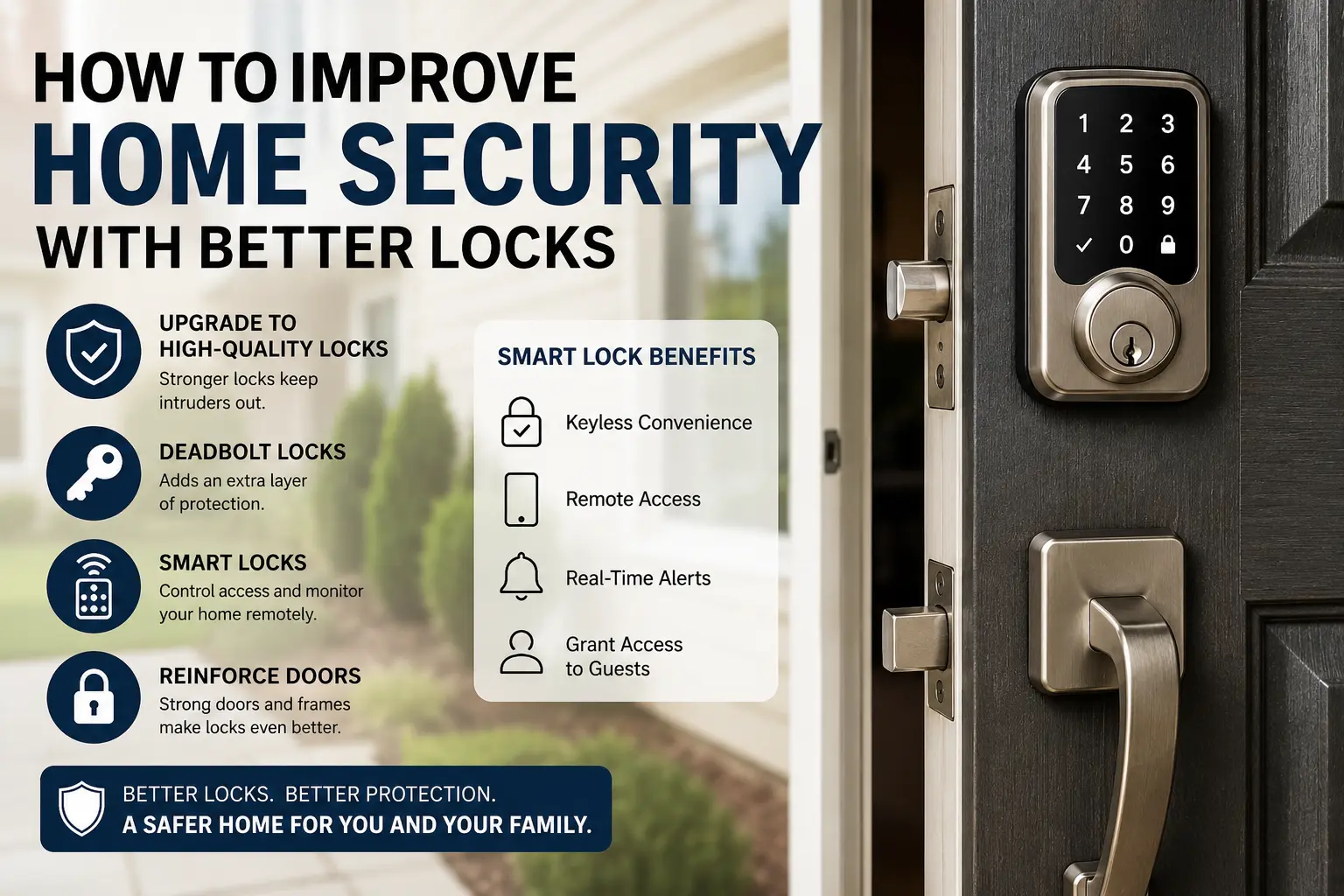
Your front door is the main way into your home. It is also the first place a thief looks. If the lock is old, weak, or poorly fitted, a thief can beat it in seconds. The good news is that you do not need to be an expert to fix this. You also don’t need to spend a lot of money.
In this guide, you will learn how to improve home security with better locks, step by step. We will use simple words and clear tips. You will learn what makes a lock strong, which lock types are worth buying, and how to protect the parts of your door that thieves attack most often. You will also learn about smart locks, common mistakes, and easy habits that keep your home safer every day.
By the end, you will have a clear plan you can follow this weekend.
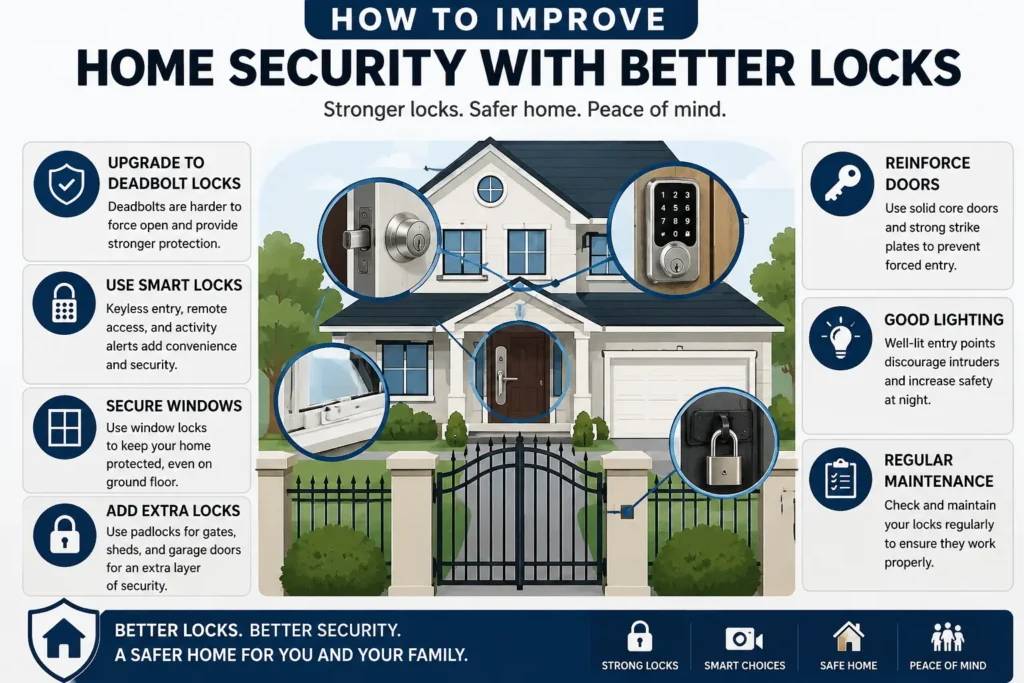
Why Better Locks Matter for Your Home
Most break-ins are not fancy. Thieves are often looking for the easiest house on the street. They try the door handle. They check for an open window. They look for a door that seems weak. If they find a lock that is hard to beat, many of them simply walk away and try another home.
That is why a strong lock is one of the best things you can add to your home. It does three jobs at once:
- It makes forced entry harder and slower.
- It makes more noise and takes more time, which thieves do not like.
- It gives you and your family peace of mind.
A better lock will not stop every thief in every case. No lock is unbreakable. But a better lock, fitted the right way, puts your home in a much safer group. Think of it like a seat belt. It does not promise nothing bad will happen, but it greatly lowers the risk.
When people ask how to improve home security with better locks, the answer has two parts. First, you choose a strong lock. Second, you make sure the door, the frame, and the fittings are strong enough to support that lock. We will cover both parts in this guide.
Step 1: Check the Locks You Have Right Now
Before you buy anything, take a walk around your home. Look at every outside door, including the front door, back door, side door, garage door, and any patio or sliding door. Ask yourself these simple questions for each one:
- Is there a deadbolt? A deadbolt is a thick metal bolt that slides deep into the door frame. A door with only a knob lock is much easier to break open.
- How old is the lock? Locks wear out. If the key sticks, the bolt feels loose, or the lock wobbles, it is time to replace it.
- Does the lock feel solid? Push and pull on it gently. A lock that moves or rattles may be badly installed or poorly made.
- Who has keys? Think about old tenants, past workers, ex-partners, and friends who once had a spare key. If you are not sure who has a copy, you have a security gap.
- What is the door made of? A strong lock on a thin, hollow door is not much help.
Write down what you find. This short list becomes your shopping and repair plan. You may find that only one or two doors need work. Or you may find that every door needs a new lock. Either way, you now know where to start.
Step 2: Learn What Lock Grades Mean
When you shop for locks in the United States, you will often see the words Grade 1, Grade 2, and Grade 3. These grades come from testing standards set by ANSI and BHMA, which are groups that test door hardware. The grade tells you how well a lock stands up to force, wear, and long use.
Here is the simple version:
- Grade 1 is the highest level. These locks are built very tough. They are used in offices and shops, and they are also a great choice for homes. If you want the strongest option, choose Grade 1.
- Grade 2 is the middle level. These locks offer strong protection for many homes at a lower price than Grade 1.
- Grade 3 is the basic level. These locks meet minimum standards. They are fine for low-risk uses, but they are not the best choice for your main entry doors.
A good rule is this: get the most secure grade you can afford for your outside doors. If your budget is tight, choose Grade 2 at a minimum for exterior doors, and try to use Grade 1 for the front door and any door that is hidden from the street.
If you live outside the United States, you may see other rating systems, such as European standards or local approval marks. The idea is the same. Look for a lock that has been tested by a trusted group, and do not rely only on claims printed on the box.
Step 3: Pick the Right Type of Lock
Not all locks work the same way. Here are the most common types, explained in plain words.
Deadbolts
A deadbolt is the most common upgrade for home security. Unlike a spring latch in a doorknob, a deadbolt does not move unless you turn the key or the thumb turn. That makes it much harder to push, pry, or slip open.
There are two main kinds:
- Single-cylinder deadbolt: You use a key on the outside and a thumb turn on the inside. This is the most popular type. It is easy to use and safe in a fire because you can unlock it quickly from inside without a key.
- Double-cylinder deadbolt: You need a key on both sides. This can stop a thief from breaking a nearby glass window and reaching in to turn the lock. But it can be dangerous in an emergency, because you must find a key to get out. Many local fire codes limit or ban this type for homes. Check your local rules before you buy one.
For most homes, a single-cylinder Grade 1 or Grade 2 deadbolt is the best choice.
When you shop, look for a bolt that sticks out at least 1 inch (about 2.5 cm) into the door frame. A longer bolt is harder to pry away from the frame.
Smart Locks
A smart lock lets you open your door with a phone, a code, a fingerprint, or a key card. Some also let you share temporary codes with guests, cleaners, or dog walkers. You can often check from your phone whether the door is locked.
Smart locks are handy, and many models carry Grade 1 or Grade 2 ratings, so they can be as strong as regular deadbolts. But they are not magic. A smart lock is only as good as its build, its software, and the way you set it up. We will talk more about this later.
Keypad Locks
Keypad locks use a code instead of a key. They are great if you often lose keys or if your kids come home before you do. Choose a model with a strong metal body, a backup key, and a long code option. Avoid codes like 1234 or your birth year.
Knob and Lever Locks
These are the locks built into door handles. They are fine for bedrooms, bathrooms, and other inside doors. But on their own, they are not enough for exterior doors. Use them together with a deadbolt, not instead of one.
Mortise Locks
A mortise lock sits inside a deep pocket cut into the edge of the door. These locks are common in older homes and in some commercial buildings. A good quality mortise lock can be very strong. If your home already has one in good shape, you may be able to keep it and just upgrade the cylinder and strike plate.
Multi-Point Locks
A multi-point lock locks the door at several places at once, often at the top, middle, and bottom. This spreads the force across the whole frame. These locks are common on European doors and on many newer patio and entry doors. They can be a very strong choice, but they must be set up and maintained well.
Step 4: Choose the Best Lock for Each Door
Different doors need different levels of protection. Use this simple guide.
Front door: This door needs your best lock. Use a Grade 1 deadbolt, or a Grade 1 smart deadbolt if you want keyless entry. Add a good strike plate and strong hinges (more on those below).
Back door: Thieves love back doors because they are hidden from the street. Treat this door like your front door. Use the same grade of deadbolt, and check that the door and frame are strong.
Garage entry door: The door that leads from your garage into your home is often ignored. Put a real deadbolt on it. If thieves get into your garage, you do not want them to walk right into the house.
Side doors and basement doors: Use at least a Grade 2 deadbolt. These doors often have weak frames, so check them closely.
Sliding glass doors: These need extra help. A basic latch can be lifted or forced. Add a secondary lock, such as a bar in the track or a pin lock, and think about adding a security film or laminated glass.
Inside doors: For rooms such as a home office or a safe room, a simple lever lock or a deadbolt can help. For bedrooms and bathrooms, a basic privacy lock is enough.
Step 5: Strengthen the Strike Plate and Door Frame
This is the step most people skip, and it is one of the most important. A strong deadbolt is only as good as the wood and metal around it. When a thief kicks in a door, the lock itself often holds. What breaks is the wooden frame that holds the strike plate.
The strike plate is the small metal plate on the door frame. The bolt slides into a hole in it. Most doors come with a short, thin strike plate held by two short screws. These screws only reach into the thin trim, not the strong wood behind it. A few strong kicks can split the frame.
Here is how to fix this:
- Replace the strike plate with a heavy-duty metal one. Look for a long plate made for security.
- Use long screws. Pick screws that are about 3 inches (7.5 cm) long. They should pass through the trim and bite into the solid stud behind it.
- Do the same on the hinge side: Replace at least one short hinge screw on each hinge with a long screw. This helps stop a thief from kicking the door in from the hinge side.
- Add a door frame reinforcement kit if your frame is old or soft. These metal strips wrap around the frame edge and make it much harder to split.
This job costs very little, often less than the price of a nice dinner, and it adds a lot of strength. If you only do one upgrade after buying a good lock, do this one.
Step 6: Check the Door Itself
A strong lock needs a strong door. Take a look at what your door is made of.
- Solid wood doors are strong and last long. Check for cracks or rot.
- Steel doors are very tough and hard to kick in. They are a popular choice for security.
- Fiberglass doors are strong and do not rot or warp. Many have a solid core.
- Hollow-core doors are light and thin. They are fine for inside rooms, but they are weak for outside doors. If you have one on an exterior entry, think about replacing it.
Also look at these parts:
- Hinges: On outward-opening doors, the hinge pins are exposed and can be removed. Use security hinges or add non-removable pins.
- Glass panels: If your door has glass near the lock, a thief can break it and reach in. Use laminated or tempered glass, add a security film, or switch to a door without glass near the lock.
- Door gaps: A large gap between the door and the frame gives a thief room to use tools. Fix a bad fit with new weatherstripping or by adjusting the hinges.
- Peephole or camera: Being able to see who is outside before you open the door is a simple but powerful safety habit.
Step 7: Protect the Lock From Common Attacks
Thieves have a few favorite tricks for beating locks. Knowing them helps you choose a lock that can resist them. You do not need to learn how to use these tricks. You only need to know what to look for when you shop.
Picking: This means using small tools to move the pins inside the lock. Locks with security pins and tight parts are much harder to pick.
Bumping: This is a quick trick that uses a specially cut key and a light tap. Many cheap locks are open to it. Look for locks that say they are bump resistant.
Drilling: Some thieves drill through the lock to destroy it. Hardened steel plates and strong inserts help stop this.
Snapping: This mostly affects a certain kind of cylinder lock used on some doors in Europe and the UK. A weak cylinder can be snapped by force. Look for cylinders marked as anti-snap and rated by a trusted group.
Prying and kicking: This is the most common attack. It is why the strike plate, the frame, and the door matter so much.
Lock covers and guard plates: A metal guard plate around the lock stops thieves from using tools on the lock body. Many good security locks include a guard ring or a hardened collar.
When you compare locks, look for words like bump resistant, pick resistant, anti-drill, and hardened steel. These are signs that the maker took security seriously. Then check for a trusted grade or approval mark. Words on the box are not enough on their own.
Step 8: Use Smart Locks the Safe Way
Smart locks are a great way to improve home security with better locks, but only if you set them up well. Here are the best habits.
Choose a trusted brand: Pick a known maker with a good record of updates and support. A cheap no-name lock may not get fixes if a problem is found.
Check the grade: Look for a smart lock with a Grade 1 or Grade 2 rating. This tells you the metal parts are built to a real standard.
Keep a physical key backup: Batteries die, and apps fail. A lock with a backup key or a way to give it emergency power from outside can save you from being locked out.
Watch the batteries: Change them on a regular schedule, and do not wait for the lock to stop working. Check them before you go on a long trip.
Secure your Wi-Fi: If your lock connects to your home network, use a strong Wi-Fi password and keep your router up to date.
Use strong passwords and two-step login: Protect the lock app the same way you protect your email. Turn on two-step login if the app offers it.
Pick strong codes: Avoid simple codes. Use a long code that is not tied to your birthday, address, or phone number.
Remove old codes: Delete temporary codes after your guests, workers, or cleaners are done. Check your code list every few months.
Keep the app updated: Updates often fix security bugs. Turn on auto-updates if you can.
Think about power cuts: Most good smart locks run on batteries, so they still work when the power is out. Check the manual to be sure.
A smart lock does not have to be your only lock. Many people like to pair a smart lock with a regular deadbolt on other doors, or keep a simple keyed deadbolt on rarely used doors. Use what feels easy and safe for your family.
Step 9: Do Not Forget Windows, Garages, and Other Weak Spots
A strong front door will not help if a thief can step through a weak window. After the doors, check these other places.
Windows: Standard window latches are made for easy daily use, not for stopping force. Add key-operated sash locks or pin locks on ground-floor windows and on windows that are hard to see from the street. Window bars or security film can help for very exposed windows. Make sure you can still get out in a fire, so keep at least one easy exit in each bedroom.
Garage doors: Many people leave the door between the garage and the house open or lightly locked. Treat that door like any other outside door. For the big garage door itself, make sure the remote is not left in a parked car. Think about using the lock on your opener when you are away for long trips.
Sheds and outbuildings: Tools in your shed, such as ladders, crowbars, and cutters, can help a thief break into your house. Lock your shed with a strong padlock and keep ladders put away.
Gates and fences: A locked gate adds one more step for a thief. Use a strong padlock or a good gate latch.
Mailbox and package spots: A mailbox stuffed with mail tells everyone you are away. Ask a neighbor to collect it, or use a mail hold service during travel.
Step 10: Install Your New Locks the Right Way
Even the best lock will not work well if it is put in badly. A loose or crooked lock can jam, wear out fast, or be easy to defeat.
If you want to do it yourself:
- Read the instructions fully before you start.
- Measure your door’s thickness and the hole sizes. Most U.S. doors use standard sizes, but always check.
- Line up the bolt and the strike plate carefully. The bolt should slide in smoothly, with no force.
- Use all the screws that come with the lock, and add longer screws where needed.
- Test the lock many times with the door open and closed before you rely on it.
If you want help from a pro:
A licensed locksmith can fit a lock quickly and fix small door problems at the same time. They can also tell you if your frame needs work. Look for a locksmith with good reviews, a local shop address, and clear prices. Be careful with ads that promise very low prices and then add extra fees at the door.
A professional install is a good idea if you have an old mortise lock, a damaged frame, a steel door, or a high-end smart lock.
Step 11: Control Who Has Your Keys
A strong lock is no help if too many people hold a copy of the key. Here are some simple key habits.
- Count your keys: Know how many copies exist and who has them.
- Rekey after a move: When you move into a new home, rekey or replace the locks. You cannot know who still has an old key.
- Rekey after a loss: If a key is lost or stolen, do not wait. Change the lock.
- Do not hide a spare key outside: Thieves know the usual spots, such as under the doormat, in a flower pot, or on top of the door frame. Give a spare key to a trusted neighbor or use a smart lock with a temporary code instead.
- Use restricted keys if you can: Some locks use keys that cannot be copied at a normal hardware store. This helps you keep control of copies.
- Never label your keys with your address: If you lose them, a stranger could find your home.
Rekeying is a low-cost way to get a fresh start. The locksmith changes the inside of the lock so old keys no longer work. It is often cheaper than buying a new lock, but if your lock is old or low grade, a full replacement is the better deal.
Step 12: Keep Your Locks in Good Shape
Locks need a little care to keep working well. A few small habits go a long way.
- Clean and lubricate once or twice a year: Use a spray made for locks, such as a dry graphite or a light lock lube. Avoid heavy oils, which can attract dirt.
- Check screws now and then: Doors move, and screws can loosen. Tighten them if the lock feels wobbly.
- Test the bolt: It should slide in and out smoothly. If you have to lift or push the door to make it lock, the door may be sagging. Adjust the hinges or the strike plate.
- Replace worn keys: A key that is worn down can be hard to turn and can damage the lock.
- Replace smart lock batteries on time: Set a reminder on your phone.
- Look for signs of tampering: Scratches, chips, or marks around the lock can mean someone tried to break in. Take them seriously.
How Much Does It Cost to Upgrade Your Locks?
Prices vary by brand, grade, and where you live. Here is a rough guide to help you plan.
- Strong deadbolt (Grade 2): A fair price for most homes. Often a modest cost per door.
- Grade 1 deadbolt: Costs more than Grade 2, but often not by a huge amount. It is usually worth it for your front and back doors.
- Smart lock: Costs more than a regular deadbolt. Prices go up with extra features such as fingerprint reading or camera links.
- Heavy-duty strike plate and long screws: Very cheap, and one of the best deals in home security.
- Locksmith labor: Depends on the job and your area. Ask for a clear quote before work starts.
- New security door: The largest cost, but the best choice if your door is weak or damaged.
If you cannot do everything at once, start with the front and back doors. Then fix the strike plates and frames. Then move on to windows, the garage, and smart upgrades.
Common Mistakes to Avoid
Many people try to improve their home security but make small mistakes that weaken the result. Here are the big ones.
- Buying a strong lock but keeping a weak frame: Always upgrade the strike plate and screws.
- Choosing price over grade: The cheapest lock often fails the first time it is tested.
- Skipping the back door: Thieves often go to the back, so give it the same care as the front.
- Leaving a spare key outside: This is one of the first places a thief checks.
- Forgetting to lock up: The best lock in the world does nothing if the door is not locked. Make it a habit.
- Using weak smart lock codes: Simple codes are easy to guess.
- Never changing codes or keys: Old keys and old codes are open doors.
- Ignoring windows: A thief will take the easy path.
- Installing the lock badly: A crooked lock can fail or jam.
- Using a double-cylinder deadbolt without checking fire rules: Safety in an emergency matters.
Your Easy Home Lock Upgrade Checklist
Use this list to plan your upgrade.
- Walk around your home and check every outside door.
- Make sure each outside door has a real deadbolt.
- Choose Grade 1 for the front and back doors if you can. Use Grade 2 as a minimum.
- Pick bump-resistant and pick-resistant models.
- Replace the strike plate with a heavy-duty one.
- Use 3-inch screws in the strike plate and hinges.
- Check that your doors are solid and in good shape.
- Fix or replace weak glass near locks.
- Add extra locks to sliding doors and windows.
- Rekey or replace locks when you move in or lose a key.
- Pick a trusted smart lock if you want keyless entry, and set it up with strong passwords and codes.
- Do not hide a spare key outside.
- Clean and check your locks twice a year.
Frequently Asked Questions
What is the best lock for a front door?
A Grade 1 deadbolt is a great choice for a front door. It is built to resist force and last a long time. If you like keyless entry, a Grade 1 or Grade 2 smart deadbolt from a trusted brand is also a good option. Whatever you choose, pair it with a strong strike plate and long screws.
Are smart locks safe?
Good smart locks can be quite safe, especially models with a Grade 1 or Grade 2 rating. They are not always safer than a regular deadbolt, though. Safety depends on strong codes, a secure Wi-Fi network, a strong app password, and regular updates. Keep a backup key in case the battery dies.
Is a deadbolt better than a regular door lock?
Yes. A deadbolt is much harder to push, pry, or slip open than a spring latch in a doorknob. For outside doors, use a deadbolt, not only a knob lock.
How often should I change my locks?
Change or rekey your locks when you move into a new home, when a key is lost or stolen, or after someone who had a key leaves your life, such as a past tenant or worker. Otherwise, a good lock can last for many years if you take care of it.
Can I install a new lock myself?
Often, yes. Many deadbolts and smart locks are made for simple installs with basic tools. But if your door is damaged, if you have a mortise lock, or if you are not sure, it is best to hire a licensed locksmith.
What is the cheapest way to make my door stronger?
Replace the strike plate with a heavy-duty one and use long screws, about 3 inches, that reach the wall stud. This low-cost change makes a big difference against kicking and forced entry.
Do I need a security system as well as better locks?
Locks are the first line of defense, and they work best when paired with other tools. Cameras, motion lights, door sensors, and alarms can add more protection. Good lighting and trimmed bushes near doors also make it harder for a thief to work unseen.
Should I choose a double-cylinder deadbolt?
Only if your local rules allow it and you understand the risk. A double-cylinder lock needs a key on both sides, which can slow your escape in a fire. For most homes, a single-cylinder deadbolt is the safer, easier choice. A better fix for glass near the lock is stronger glass or security film.
Final Thoughts: Start Small and Build a Safer Home
Now you know how to improve home security with better locks. The main steps are simple. Check what you have now. Choose a strong lock with a good grade. Upgrade the strike plate and the screws. Make sure the door and the frame are solid. Add smart features if you like them, and use them safely. Control who has your keys, and take care of your locks over time.
You do not need to do everything in one day. Start with your front and back doors. Add a Grade 1 or Grade 2 deadbolt, then fix the strike plates. Next, look at your windows, your garage door, and your sliding doors. Small steps add up fast.
A safe home is not about fear. It is about feeling calm when you leave for work, go on holiday, or go to sleep at night. Better locks will not fix every risk, but they are one of the smartest and most affordable ways to protect the people and things you love.
Pick one door today. Check it, upgrade it, and test it. Your future self will be glad you did.
