


A dripping tap. A loose door. A shelf that needs to go on the wall. A fence gate that will not close. Every home has small jobs like these, and they pile up fast. Most of us do not have the time, the tools, or the skills to fix them all. That is when a handyman can save the day.
But here is the big question many people ask: what qualifications should I look for when hiring a local handyman service? It is a smart question. A good handyman can fix your home quickly and fairly. A bad one can leave you with a bigger mess, a lighter wallet, and a lot of stress.
In this guide, we will walk through everything in plain and simple words. You will learn which papers to check, which skills matter, which questions to ask, and which warning signs to watch out for. By the end, you will know how to pick a handyman you can trust.
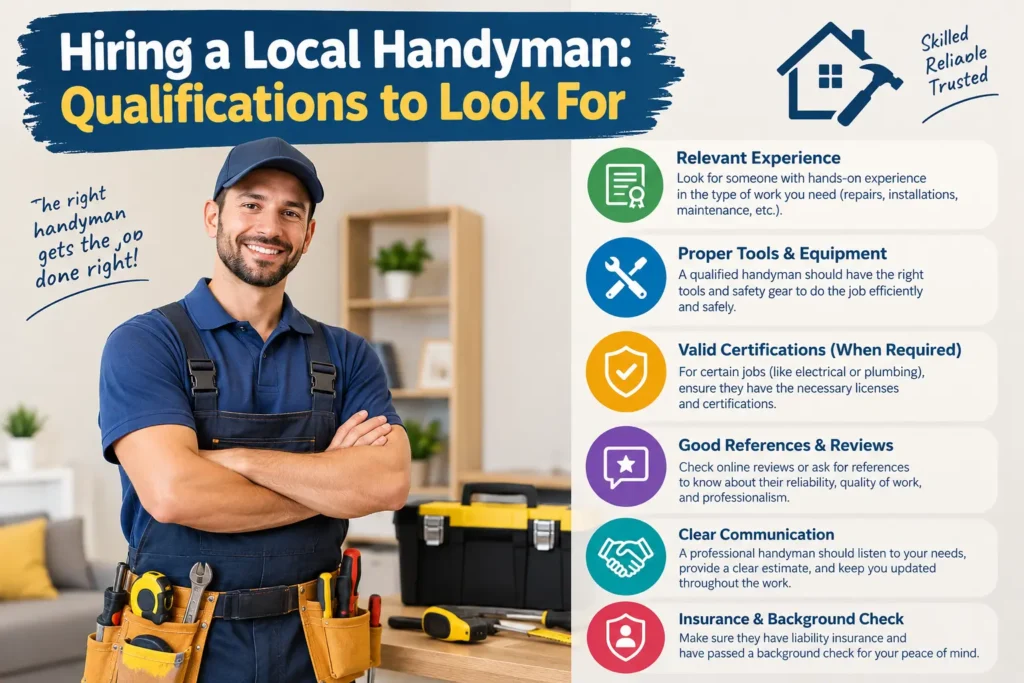
What Does a Handyman Do?
Before we talk about qualifications, let us make sure we know what a handyman is. A handyman is a person who does many kinds of small repair and home jobs. Think of them as a helper who knows a little about a lot of things.
Here are some jobs a handyman often does:
- Fixing doors, windows, and cabinets
- Hanging pictures, mirrors, shelves, and TVs
- Putting furniture together
- Patching small holes in walls
- Painting a room or touching up paint
- Fixing small leaks and changing tap parts
- Changing light bulbs, fixtures, and switch covers
- Caulking around tubs, sinks, and windows
- Repairing fences, gates, and decks
- Cleaning gutters and doing small yard fixes
- Installing curtain rods, blinds, and door locks
A handyman is not the same as a contractor. A contractor usually handles bigger jobs, like building a new room, replacing a roof, or rewiring a house. Those jobs often need special licenses and permits. Some jobs, like major electrical or gas work, should only be done by a licensed trade worker. A good handyman knows this and will tell you honestly when a job is too big or too risky for them.
Knowing this difference is your first step. When you know what kind of help you need, it gets much easier to check if a person is the right fit.
Why Qualifications Matter So Much
You may wonder, “It is just a small repair. Why does it matter so much who I hire?”
There are a few good reasons.
Your home is a big investment: A poor repair can cause damage that costs far more to fix later. A tiny leak that is fixed the wrong way can turn into a rotten wall.
Safety comes first: Bad work on stairs, railings, or anything near wires can hurt someone in your family.
Money is on the line: If the person you hire does not finish the job, or does it badly, you may have to pay twice.
Strangers will be in your home: You are letting someone walk around your space and handle your things. You want to feel safe and respected.
Good qualifications help you feel sure about the person you choose. Let us look at each one.
1. Check for the Right License and Business Papers
The first thing to look at is whether the handyman is allowed to work legally in your area.
Rules are different in different places
Every state, city, or country has its own rules. In some places, a handyman needs a license to do any work at all. In other places, there is no special handyman license, but there may be a limit on how big a job can be before a contractor’s license is needed. Some places say that jobs over a certain price need a license.
So your first step is to find out what the rules are where you live. Your local city or town office, or your state’s licensing board, can tell you. Most have a website where you can look this up for free.
Ask about a business license
Even when a handyman license is not needed, most local handymen still need a business license or registration to run their business. This shows that the person is a real, registered business and not someone who might disappear tomorrow.
Ask to see it. A real professional will not mind. They will be happy to show you.
Check special trade licenses for special jobs
Some jobs are not for a general handyman. Jobs with plumbing pipes, gas lines, and electrical wiring often need a licensed plumber or electrician. If you need that kind of work done, ask the handyman if they hold the right license. If they do not, the honest thing for them to say is, “That job needs a licensed pro.”
If a handyman says yes to every job without any hint of a limit, be careful. It may mean they do not know the rules, or they do not care.
How to check a license
- Ask for the license number.
- Look it up on your local or state licensing website.
- Make sure the name matches the person you are talking to.
- Check that the license is still active and has no big complaints.
This takes only a few minutes and can save you a lot of trouble.
2. Make Sure They Have Insurance
If you remember only one thing from this guide, let it be this one: ask about insurance.
Many people forget this step. But insurance is what protects you when something goes wrong, and sometimes things do go wrong, even with very good workers.
General liability insurance
This covers damage to your home or your things. Say a handyman drops a heavy tool through your glass table, or a leak ruins your floor while they work. With liability insurance, the insurance company can pay for the damage. Without it, you may have to pay yourself, or fight to get the money from the handyman.
Workers’ compensation insurance
This covers workers who get hurt on the job. Imagine a handyman falls off a ladder in your yard. If they have no workers’ compensation and they work for a company, you could face a huge problem. In some places, a homeowner can even be blamed for the injury. If the handyman works alone, ask how they are covered. Rules differ, but the question is always fair.
Ask for proof
Do not just take their word for it. Ask for a certificate of insurance. This is a paper from the insurance company that lists what is covered and for how long. You can also call the insurance company and check that the plan is still active. A real pro will give you this without any fuss.
A bonded handyman is another plus. A bond is a type of promise backed by a third party. If the handyman does not finish the work or breaks the rules, the bond can help pay you back.
3. Look at Their Experience
Years of work matter. A person who has fixed hundreds of doors, walls, and taps has learned lessons that no book can teach.
How many years have they worked?
Ask how long they have been doing handyman work. There is no magic number, but a few years of steady work is a good sign. A newer handyman can still be good, especially if they trained under an experienced pro. Just ask more questions in that case.
Do they have experience with your type of job?
This is a key point. A handyman may be great at painting but not so good at fixing doors. Ask directly: “Have you done this kind of job before?” Then ask them to describe how they would do it. Listen to the answer. A skilled person can explain the steps in a clear and calm way.
Ask about training
Some handymen learn on the job. Others go to trade school or work as helpers for a licensed worker. Either path can work. What you want to hear is that they have real, hands-on time doing the work, not just a few videos watched online.
Ask to see past work
Photos of earlier jobs are very helpful. A good handyman often keeps a folder of pictures on their phone or on a website. Look for neat lines, clean finishes, and work that looks like the job you want.
4. Check Their Skills and Tools
A handyman is a “jack of many trades,” so a wide skill set is a good thing. Here are some skills to look for.
Basic carpentry: Fixing doors, trim, shelves, and small wood parts.
Drywall and painting: Patching holes so they cannot be seen, and painting a clean, even coat.
Simple plumbing: Changing a tap, fixing a running toilet, or clearing a small clog.
Simple electrical work: Changing a light fixture or a switch cover safely, and knowing when to stop.
Assembly and installation: Building furniture, hanging TVs, and mounting shelves in the right place.
Problem solving: Old homes have strange surprises. A good handyman can think on their feet.
Do they bring the right tools?
A pro should arrive with their own tools and a clean, well-kept truck or toolbox. If a handyman asks to borrow your drill or your ladder, that is a warning sign. It may show they are not set up for real work.
Do they know their limits?
This may be the best skill of all. A strong handyman will tell you, “This is outside what I do. You need a licensed electrician.” That honesty protects you. Be careful with anyone who says, “I can do anything!”
5. Read Reviews and Ask for References
What other people say about a handyman is one of the best clues you can get.
Online reviews
Look at review sites, social media pages, and local community groups. Search for the handyman’s name or business name. Do not look only at the star rating. Read the actual words. Look for patterns.
Good patterns to see:
- “Showed up on time.”
- “Cleaned up after the job.”
- “Price was fair and matched the quote.”
- “Explained everything clearly.”
Bad patterns to watch for:
- “Did not show up.”
- “Price kept going up.”
- “Left a mess.”
- “Work fell apart after a week.”
One bad review is normal. Nobody makes everyone happy. But the same complaint again and again is a red flag. Also look at how the handyman answers bad reviews. A calm, polite reply shows maturity.
Ask for references
A good handyman can give you the names and phone numbers of two or three past customers. Call them. Ask simple questions:
- Was the work done on time?
- Was the final price the same as the quote?
- Was the handyman polite and clean?
- Would you hire them again?
It takes about ten minutes, and it can tell you more than any advertisement.
Ask friends and neighbors
Word of mouth is powerful. Ask people you trust who they use. Someone who has had a good experience will often be happy to share a name.
6. Look for Certifications and Trade Group Memberships
Certifications are not always required, but they can be a nice plus. They show that a person cares about their craft and keeps learning.
Some handymen join trade groups. In the United States, for example, there are groups for handyman professionals and for the remodeling trade. Being a member often means the person follows a code of good conduct and stays up to date on best practices.
Some jobs also call for product-specific training. For example, a person who installs certain roofing or flooring products may need a special certificate from the maker. If your job uses special materials, it is fair to ask if the handyman is trained to work with them.
Note that a missing certificate is not always a deal breaker. Plenty of excellent handymen have no fancy papers. But if they do have them, it is a good extra sign.
7. Pay Attention to How They Communicate
You can learn a lot about a person from how they talk to you before the job even starts. Good communication is a real qualification.
Do they answer your calls and messages?
If it takes days for a handyman to reply to your first message, imagine how it will be when you have a problem in the middle of the job. Quick, polite replies are a great sign.
Do they listen?
A good handyman asks questions about your project. They want to know what you need, what you expect, and what your budget is. They do not just throw out a price in ten seconds without seeing the job.
Do they explain things in simple words?
You should not feel confused or talked down to. A good pro explains the problem, the fix, and the cost in clear terms.
Are they on time?
Showing up on time for the first visit or quote is a small test. If they are late with no call, the same thing may happen on the day of the work.
Are they respectful?
A handyman should be polite, clean, and careful in your home. They should protect your floors, wipe their boots, and clean up when they finish.
Trust your gut. If something feels off, it is fine to say no and keep looking.
8. Get a Written Estimate and Contract
A good handyman puts things in writing. This protects both of you.
What a good written estimate includes
- Your name and address and the handyman’s name and contact details
- A clear list of the work to be done
- The cost of labor and the cost of materials
- The total price
- The start date and the expected finish date
- How and when payment is due
- Any warranty on the work
Why a contract matters
For bigger jobs, ask for a short written agreement. It should match the estimate. If anything changes during the work, such as extra repairs found behind a wall, the change should be written down and agreed on before the extra work starts. This stops the dreaded “surprise bill.”
Compare more than one quote
Try to get at least two or three estimates. This helps you see what a fair price looks like. But do not just pick the cheapest. A very low price can be a sign of poor work, weak materials, or a plan to add costs later.
9. Watch Out for Payment Red Flags
How a handyman asks to be paid says a lot about them.
Never pay everything upfront: A small deposit for materials on a bigger job can be normal. But a handyman who wants all the money before starting is a big warning sign.
Be careful with cash-only demands: Some people prefer cash, and that is not always bad. But when a person refuses to give any receipt or written record, think twice.
Pay in steps for big jobs: A good plan is a small deposit, a payment halfway, and the final payment when you are happy with the finished work.
Keep receipts: Always ask for a receipt or an invoice. It is proof that you paid and may help if there is a problem later.
Pay the final bill only after you walk around and check the work. If something is not right, say so before you pay.
10. Ask About a Warranty or Guarantee
A handyman who is proud of their work will stand behind it. Ask, “What happens if something goes wrong after you leave?”
Some offer a guarantee on labor for a set time, such as thirty days, ninety days, or a year. Materials often have a warranty from the maker. Ask for these promises in writing.
A handyman who says “That is not my problem once I am gone” is not one you want in your home.
11. Questions to Ask Before You Hire
Here is a handy list you can use on the phone or at your first meeting.
- How long have you worked as a handyman?
- Do you have a business license? Can I see it?
- Are you insured? Can you send proof?
- Have you done this type of job before?
- Can I see photos of your past work?
- Can you give me two or three references?
- Will you give me a written estimate?
- How do you charge: by the hour or by the job?
- Do you buy the materials, or do I?
- How long will the job take?
- Do you work alone or with a helper?
- What is your payment plan?
- Do you offer a guarantee on your work?
- What happens if you find extra problems during the job?
- Will you clean up when you finish?
A good handyman will answer all of these without getting upset. If they dodge, get angry, or give vague answers, that tells you something.
12. Common Red Flags to Watch For
Sometimes the best qualification is simply the lack of warning signs. Be careful if you see any of these:
- Pressure to decide right now: “This price is only good today!” is a classic trick.
- Door-to-door offers: Someone knocks and says they “noticed a problem” with your roof or yard. Good handymen usually do not need to find work this way.
- No address or phone number: If there is no way to find them later, that is risky.
- No written estimate: A promise on a handshake is not enough.
- Unmarked vehicle and no business name: This is not always bad, but be extra careful.
- Demands for large upfront cash: Walk away.
- Says no permit is needed when one is: Some jobs need a permit. Skipping one can cause trouble when you sell your home.
- Bad-mouths other workers: Professionals focus on their own work.
- Reviews that look fake: If all the reviews sound the same or were posted on the same day, they may not be real.
One warning sign may be small. Several together are a clear message to find someone else.
13. Where to Find a Good Local Handyman
Now you know what to look for. But where do you find candidates?
Ask people you know: Friends, family, neighbors, and coworkers are the best source. A personal tip is often more reliable than an ad.
Local community groups: Neighborhood pages and local forums often have people sharing names of workers they liked.
Home service websites and apps: Many platforms list local pros, with reviews and prices. They can save time, but still do your own checks on license, insurance, and references.
Local hardware and home stores: Staff often know which handymen are around and respected.
Local business listings: A simple search for handyman services near you will show many results. Read the reviews, visit their websites, and look for clear contact details.
Property managers and realtors: These people hire handymen all the time and often know the reliable ones.
14. How Much Does a Local Handyman Cost?
Prices differ a lot from place to place, so we will keep this general.
Most handymen charge in one of two ways:
- By the hour: This works well for small, mixed jobs, like fixing five little things in one visit.
- By the job: This is a flat price for one clear task, like hanging a TV or painting a room.
Some handymen also have a minimum fee for a visit, because travel and set-up take time.
Several things change the price:
- The size and difficulty of the job
- The cost of materials
- Where you live
- The skill level of the worker
- How fast you need it done
A fair price is not always the lowest price. It is a price that matches the quality of the work, the skill of the person, and the time needed. Ask for a clear breakdown so you know what you are paying for.
15. A Simple Step-by-Step Plan to Hire the Right Handyman
Let us put it all together into an easy plan.
Step 1: Write down your job list: Make a clear list of what you need done. Add photos if you can.
Step 2: Set a budget: Know how much you are ready to spend.
Step 3: Find three candidates: Use friends, neighbors, and trusted websites.
Step 4: Check the basics: Look at their license, business papers, and insurance.
Step 5: Read reviews and call references: Look for steady, positive stories.
Step 6: Ask your questions: Use the list above.
Step 7: Get written estimates: Compare the details, not just the price.
Step 8: Sign a simple agreement: Make sure the scope, price, and timeline are written down.
Step 9: Pay fairly and in steps: Never pay everything upfront.
Step 10: Check the finished work: Walk through the job before the final payment.
Step 11: Keep your papers: Save the contract, receipts, and warranty in one folder.
Step 12: Leave a review: If the handyman did a great job, tell others. It helps good workers get more business.
Handyman or Contractor: Which Do You Need?
Sometimes people are not sure which kind of worker to hire. Here is a simple way to think about it.
Hire a handyman when the job is small, quick, and low risk. Examples are hanging shelves, fixing a door, patching a wall, or replacing a tap washer.
Hire a contractor or licensed trade worker when the job is large, complex, or risky. Examples are rewiring, moving gas lines, building an addition, replacing a roof, or changing the structure of your home. These jobs often need permits and special skills.
If you are not sure, ask the handyman. An honest one will tell you where the line is.
Tips to Get the Best Results From Your Handyman
Hiring well is only half the job. Here is how you can help the work go smoothly.
- Be clear about what you want: The more detail you share, the fewer mistakes happen.
- Group your jobs: Many handymen offer a better rate for several tasks in one visit.
- Clear the work area: Move furniture and fragile items out of the way.
- Be home for the start: Show them the work and answer questions.
- Ask before changes: If something new comes up, talk about price and time first.
- Say thank you: A kind word goes a long way. Good workers remember good customers.
- Keep a list for next time: Once you find a great handyman, keep their number. Having a trusted helper on call is a real gift.
Frequently Asked Questions
What qualifications should I look for when hiring a local handyman service?
Look for the right license or business registration, proof of insurance, real experience with your type of job, good reviews, references from past customers, and clear written estimates. Good communication and honest pricing are also very important.
Does a handyman need a license?
It depends on where you live. Some places require a license, some only require a business registration, and some limit the size of jobs a handyman can do without a contractor’s license. Check with your local or state office to learn the rules in your area.
Is a handyman insured?
A good one should be. Always ask for a certificate of insurance. Liability insurance protects your home, and workers’ compensation can protect against injury claims.
How do I know if a handyman is trustworthy?
Check reviews, call references, ask for proof of license and insurance, and see if they give you a written estimate. Watch how they communicate. A trustworthy person is open, honest, and not pushy.
How much should I pay upfront?
For small jobs, many handymen ask for nothing upfront. For bigger jobs, a small deposit to buy materials can be fair. Be careful if anyone asks for full payment before they begin.
Should I get more than one quote?
Yes. Getting two or three quotes helps you understand the fair price and spot anything that seems too high or too low.
What jobs should a handyman not do?
Major electrical work, gas line work, big plumbing changes, and structural changes should go to licensed professionals. A good handyman will tell you when a job is beyond their scope.
What if I am not happy with the work?
Talk to the handyman first and calmly explain the problem. Point to your written agreement. A good professional will want to make it right. If they refuse, you can contact your local consumer office or licensing board for help.
Can I hire a handyman for just one small job?
Of course. Many handymen are happy to take small jobs, though some have a minimum fee for a visit. It can be smart to bundle a few small jobs into one visit.
How can I find a handyman fast in an emergency?
Start with people you know and trusted local listings. Even in a hurry, take a minute to check the license and insurance. For true emergencies like a burst pipe, shut off the water first if you can, then call a licensed plumber.
Final Thoughts
So, what qualifications should I look for when hiring a local handyman service? The short answer is this: a valid license or business registration, proper insurance, real experience, good reviews, honest communication, a written estimate, and fair payment terms.
None of this is hard. It only takes a little time and a few good questions. Spending an hour on research can save you days of stress and hundreds of dollars in repairs.
Remember that the best handyman is not always the cheapest or the quickest. It is the one who shows up on time, does clean work, tells you the truth, and stands behind the job. When you find a person like that, keep their number close. A good local handyman is like a good neighbor: always handy when you need them.
Now you have everything you need. Make your list, ask your questions, check the papers, and hire with confidence. Your home will thank you.
