

Every homeowner has the same dream. You want a home that looks fresh, feels good, and works well. But you also want to keep your money in your pocket. That is why so many people look for the best home improvement cost for DIY renovation projects. You want to know which jobs are cheap, which jobs give you the most value, and which jobs are worth doing yourself.
The good news is that doing the work yourself can cut your bill by a lot. Surveys from the home improvement industry show that a project a pro would charge thousands of dollars for can cost far less when you do it yourself. One report from the Home Improvement Research Institute compared a project that cost $8,454 with a pro to just $979 as a full DIY job. A mixed job, where the owner does part of the work and hires a pro for the rest, landed in the middle at about $5,774. Another guide says you can save up to 83 percent on some jobs.
Those numbers sound great. But they are not magic. DIY only saves money when you pick the right project, plan your budget, buy smart, and know your limits. A bad plan can cost more than hiring a pro, because mistakes are expensive to fix.
In this guide, we will walk through everything in plain words. You will learn what drives home improvement cost, which DIY renovation projects give you the best price, how to build a budget, how to save on tools and materials, and when to call a professional. By the end, you will have a clear plan for your next project.
Let’s get started.
What Does “Home Improvement Cost” Really Mean?
Before we look at projects, let’s make sure we talk about cost the right way. Many people only think about the price of paint or boards. But the real cost of a DIY renovation has several parts.
1. Materials
This is the stuff you buy: paint, tiles, wood, screws, flooring, glue, and so on. Materials are the biggest part of most DIY budgets because you are not paying anyone for labor.
2. Tools and Equipment
You may need a drill, a saw, a level, a ladder, or a tile cutter. If you already own them, great. If not, you must buy, rent, or borrow them. This part of the cost is easy to forget.
3. Hidden and Extra Costs
Things go wrong. A wall may hide damage. A pipe may leak. You may need a permit. You may also need to haul away old materials. A smart DIYer adds an extra 10 to 20 percent to the budget for surprises.
4. Your Time
Time is a real cost too. A pro may finish a bathroom in one week. You may need three weekends. If you must take days off work, or if you will live in a messy home for a long time, count that.
5. Long-Term Value
The cheapest project is not always the best. A good renovation should make your home nicer to live in, and in many cases raise its value. The best home improvement cost is not just the lowest price. It is the best mix of low price, good result, and long-term benefit.
Why DIY Renovation Saves So Much Money
The main reason DIY is cheaper is simple: labor. When you hire a contractor, a large share of your bill goes to wages. For many renovation jobs, labor can be as much as half of the total price. When you do the work, that part of the bill goes away.
The savings are even bigger on jobs where the labor is skilled and costly. Kitchen and bathroom projects are good examples. Pros charge more for them, so doing parts yourself can save the most money.
Here are other reasons DIY can help your wallet:
- You control the budget: You choose each item and each price.
- You can work slowly: You can wait for sales and buy when prices are low.
- You avoid contractor markups: Many contractors add a fee on top of materials.
- You can split the job: You can do the easy parts and hire help for the hard parts.
Still, remember that DIY is not for every job or every person. Be honest about your skills, your time, and your patience.
Quick Look: Typical DIY Renovation Costs
Prices change by city, store, and material quality. The numbers below are rough ranges to help you plan. Always check local prices before you buy.
| Project | Typical DIY Cost | Skill Level | Time Needed |
|---|---|---|---|
| Paint one room | $100 – $300 | Beginner | 1 – 2 days |
| Paint whole interior | $500 – $1,500 | Beginner | 1 – 2 weekends |
| Swap cabinet handles | $50 – $200 | Beginner | A few hours |
| New light fixtures | $50 – $400 | Beginner/Medium | 1 day |
| Peel-and-stick backsplash | $100 – $400 | Beginner | 1 day |
| Tile backsplash | $300 – $900 | Medium | 2 – 3 days |
| Vinyl plank flooring (room) | $400 – $1,500 | Medium | 1 – 2 days |
| Cabinet painting (kitchen) | $200 – $700 | Medium | 1 weekend |
| Raised garden bed (kit) | $300 – $900 | Beginner | 1 day |
| Floating shelves | $50 – $250 | Beginner | A few hours |
| DIY kitchen refresh | $1,200 – $4,000 | Medium | 2 – 3 weeks |
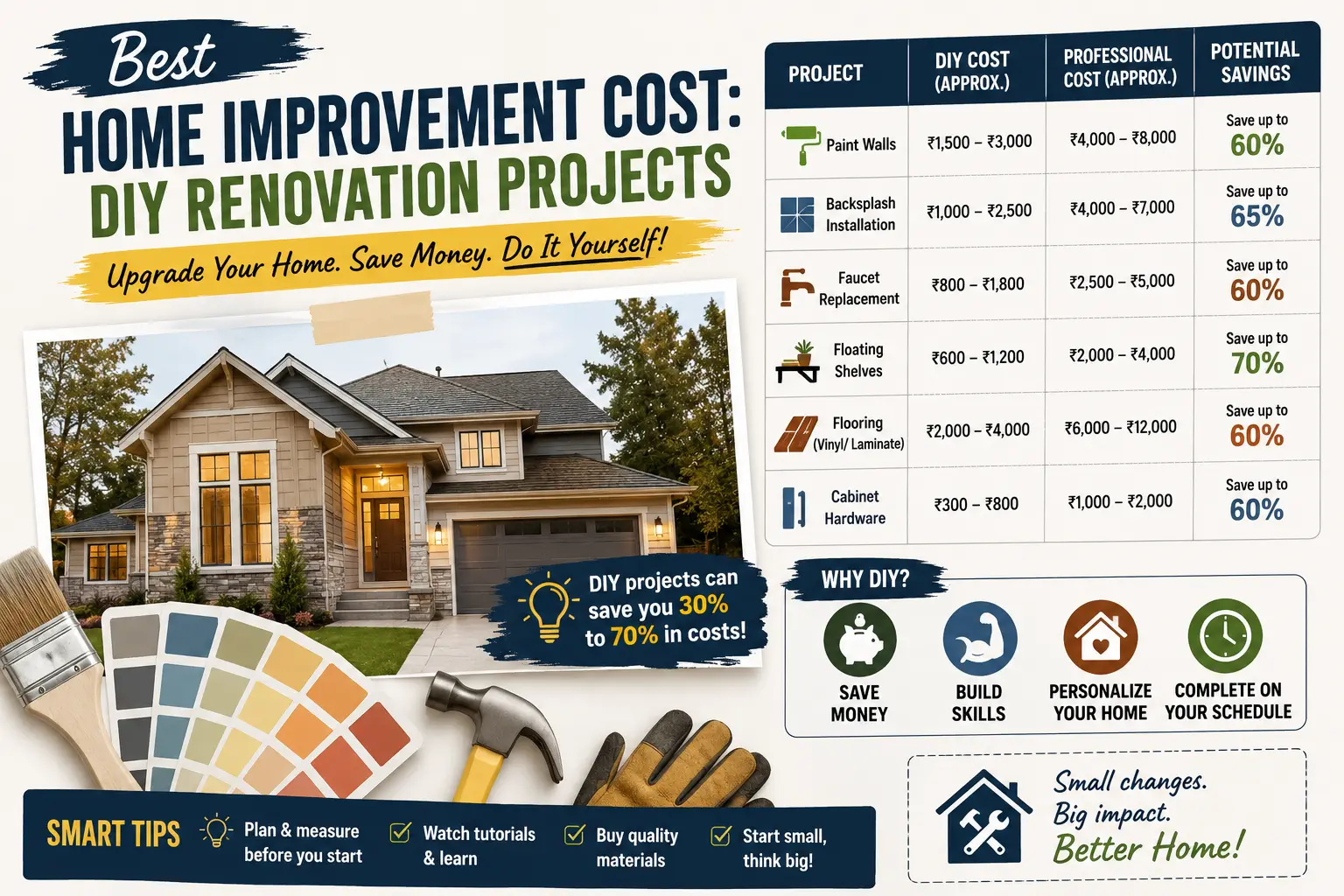
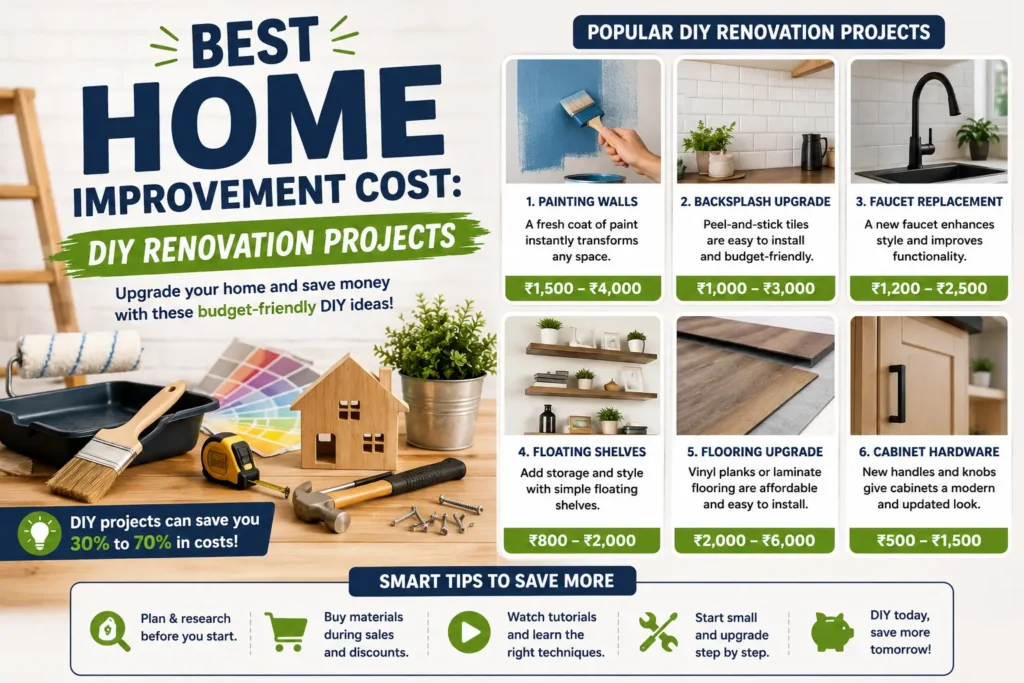
Notice how most of the top jobs fall under $1,500. These are the projects that bring the best home improvement cost for DIY renovation projects, because the price is low and the visible change is big.
The Best Low-Cost DIY Renovation Projects
Let’s go through the projects that give you the most for the least money.
1. Paint Your Walls
If you ask any expert which DIY project is best for beginners, painting wins almost every time. It is cheap, it is easy to learn, and it changes the look of a room fast.
A gallon of good interior paint often costs between $30 and $60. Add rollers, brushes, tape, and a drop cloth, and a single room can cost around $100 to $300 in total. A pro might charge several times that. One money expert says painting is always the best DIY project to save money, especially for beginners, and that a whole home interior can be done for roughly $500.
Tips to keep painting cost low:
- Use painter’s tape to get clean lines.
- Fill small holes and cracks before you paint.
- Buy one big can instead of many small ones.
- Pick light colors to make small rooms feel bigger.
- Do not skip primer on dark or stained walls.
Painting is also a great way to lift your home’s value if you plan to sell. Fresh, neutral walls make a home look clean and cared for.
2. Update Cabinet Handles and Doors
If your kitchen or bathroom looks tired, you may not need new cabinets. New handles and knobs can change the whole feel for very little money. A pack of ten decorative handles can cost just over ten dollars in many stores, and a full set for a kitchen is often under $200 even if you choose nicer styles.
Want more impact? Paint the cabinets. A kitchen cabinet repaint can cost between $200 and $700 for paint, primer, and supplies, while replacing cabinets can cost many thousands. Take the doors off, clean them well, sand lightly, prime, and paint with a durable cabinet paint. Let each coat dry fully.
3. Change Light Fixtures
Old lights can make a room look dated. A new fixture can make it bright and modern. Simple swaps, like changing a ceiling light or a bathroom vanity light, can cost $50 to $400 per fixture.
Safety note: Always turn off the power at the breaker before you touch any wiring. If you are not sure how to do it, hire a licensed electrician. Safe is better than cheap.
4. Add a Peel-and-Stick Backsplash
A backsplash protects your wall from splashes and adds style. Real tile is lovely but needs more skill and money. Peel-and-stick tiles are cheaper and easy to install. You cut them, peel off the back, and press them on the wall. A small kitchen can be done in a day for about $100 to $400.
If you want the real tile look, a tile backsplash is still a good DIY project for a patient beginner. Plan for $300 to $900 for tile, adhesive, grout, and tools.
5. Install Vinyl Plank or Laminate Flooring
Flooring can be one of the biggest costs in a renovation. Pros charge a lot for labor. Today, click-together vinyl plank and laminate floors make DIY much easier. The boards snap into one another, and many types float over your old floor without glue or nails.
A bedroom or small living room can often be done for $400 to $1,500, depending on the style you choose. Measure your room carefully and buy about 10 percent extra for cuts and mistakes. Let the boards sit in the room for a day or two before you lay them so they can adjust to the air.
6. Build Floating Shelves
Shelves add storage and style. A simple floating shelf takes a board, brackets or hidden supports, and a few screws. You can build a few shelves for $50 to $250. Find the wall studs, use a level, and use the right wall anchors for the weight you plan to hold.
7. Refresh Your Bathroom the Smart Way
A full bathroom remodel is costly. But a bathroom refresh is not. You can:
- Paint the walls and ceiling.
- Replace the faucet and shower head.
- Change the mirror and light.
- Re-caulk the tub and sink.
- Add new towel bars and hooks.
- Re-grout old tile.
These small steps can cost under $500 together, yet the room will look much newer. This approach gives one of the best returns for your money.
8. Boost Curb Appeal
The outside of your home is the first thing people see. Small updates make a big difference:
- Pressure wash the walkway and siding.
- Paint the front door in a bold color.
- Replace house numbers, the mailbox, and the doorbell.
- Plant flowers, shrubs, and fresh mulch.
- Fix or paint the fence.
House numbers can be less than ten dollars each, a doorbell about seven, and a gardening tool set around fifteen dollars. For under $300 you can lift your home’s look and feel proud when you pull into the driveway.
9. Seal Drafts and Improve Energy Use
This one saves you money every month. Caulk gaps around windows and doors, add weatherstripping, and install door sweeps. You can also switch to LED bulbs and add a smart thermostat. These steps cost little and cut your energy bills. They are also quick weekend jobs.
10. Build a Raised Garden Bed
A custom-built raised bed can cost $1,200 to $4,000 if you hire someone. A DIY kit often costs $300 to $900, and you can build your own from lumber for even less. A raised bed gives you fresh herbs and veggies and makes your yard look better too.
Mid-Range DIY Projects Worth the Effort
Once you build your skills, you can try bigger jobs. These cost more and take more time, but they can bring real savings.
DIY Kitchen Refresh
A full kitchen remodel with a pro can reach tens of thousands of dollars. But a kitchen refresh is a smarter DIY path. Paint or reface the cabinets, change the hardware, add a backsplash, swap the faucet, update the lights, and add new paint or flooring. Many homeowners complete a refresh like this in the $1,200 to $4,000 range, depending on the materials.
If you want to save even more, keep the layout the same. Moving pipes, gas lines, and wires is where costs rise quickly.
Build a Deck or Patio
A simple ground-level deck or a paver patio can be a great DIY job. It takes planning and muscle, but the skills are learnable. Since labor is a big part of outdoor build costs, doing it yourself can save thousands. Check your local rules first, because some decks need a permit.
Install a Tile Floor or Shower Surround
Tile work is slow but doable. It needs a flat surface, the right adhesive, and patience. If you do the tile yourself and hire a plumber only for the pipes, you can keep the cost under control.
Finish a Basement or Garage Corner
Adding a small office, play space, or gym can add living space without building an addition. You can frame, insulate, and drywall some parts yourself and bring in pros for the electric and plumbing work.
Projects You Should Leave to the Pros
Part of finding the best home improvement cost is knowing when not to DIY. A general rule: leave anything that affects your home’s structure, electricity, gas, or major plumbing to a licensed pro.
Here is a short list of jobs that are risky for most homeowners:
- Removing load-bearing walls: A mistake can harm the whole structure.
- Main electrical panel work: Wrong wiring can cause fires and shocks.
- Gas line work: Leaks can be deadly.
- Roof replacement: It is dangerous, heavy, and easy to get wrong.
- Major plumbing changes: Water damage can cost far more than the job itself.
- Asbestos or lead paint removal: These need special training and gear.
A wise middle path is to do the simple parts yourself and hire a pro for the risky parts. This “hybrid” approach can still save a lot. For example, you can handle demolition, painting, and cleanup, and let a pro do the wiring or pipes.
Also check your local laws. Many cities require permits and inspections for certain work. Skipping them can lead to fines and trouble when you sell the home.
How to Build a Smart DIY Renovation Budget
A good budget keeps your project from running out of control. Follow these simple steps.
Step 1: Decide Your Goal
Ask yourself why you are renovating. Is it to enjoy your home more, fix a problem, or raise the resale value? Your goal helps you choose where to spend and where to save.
Step 2: List Every Task
Write down each step of the project. For a bathroom refresh, that might be: remove old fixtures, patch walls, prime, paint, install new faucet, caulk, and add accessories. A long list helps you see all the costs.
Step 3: Price Materials and Tools
Visit stores or check online prices. Get at least three price checks for big items. Add the cost of tools you do not own.
Step 4: Add a Safety Buffer
Add 10 to 20 percent to your total for surprises. Old homes often hide problems behind walls and floors. If you do not use the buffer, great. If you need it, you will be glad it is there.
Step 5: Set a Timeline
A slow project can cost more in stress and extra costs. Give yourself a realistic schedule. Remember that most DIY jobs take longer than you think.
Step 6: Track Every Dollar
Use a simple notebook or a spreadsheet. Write down what you spend each day. This helps you spot overspending early.
Tools: Buy, Rent, or Borrow?
Tools can quietly eat your budget. Here is how to decide.
Buy: tools you will use again and again. A good drill, a tape measure, a level, a hammer, a utility knife, and a set of screwdrivers are worth owning.
Rent: tools for single-use jobs. A tile saw, floor sander, or pressure washer can be rented by the day at many hardware stores. Renting is much cheaper than buying a tool you will use once.
Borrow: from friends, family, or neighbors. Many towns also have tool libraries where you can borrow tools for free or a small fee.
Buy used: Local marketplaces, garage sales, and secondhand shops are full of good tools at low prices.
A simple starter kit for most DIY renovation work includes:
- Cordless drill and driver bit set
- Tape measure and level
- Hammer and pry bar
- Utility knife and putty knife
- Caulk gun
- Stud finder
- Safety glasses, gloves, and a dust mask
- Step ladder
Do not skip safety gear. A trip to the doctor costs far more than a pair of glasses.
Smart Ways to Save Money on Materials
Materials are where most of your DIY money goes. Here are easy ways to spend less.
Shop Sales and Seasons
Stores run big sales on holidays and at the end of seasons. Paint, tools, and flooring often go on sale in spring and fall. Plan ahead and wait for good deals.
Check the “Oops” Paint Shelf
Most paint stores have a shelf of mixed paint that someone did not pick up. It is sold at a big discount and works well for closets, garages, and small rooms.
Use Salvage and Habitat Stores
Some charity stores sell used doors, cabinets, sinks, and lights at very low prices. These items often have lots of life left in them.
Buy Quality Where It Matters
Cheap is not always cheaper. Spend more on items you touch or use every day, like faucets, door hardware, and flooring. Save on things that are less visible.
Compare Online and In-Store Prices
Check both. Some stores will match a lower price if you show it to them. Also ask about contractor or loyalty discounts.
Order a Little Extra, But Not Too Much
Always buy a bit more than you need for waste, mistakes, and later repairs. But keep your receipts, because many stores accept returns on unopened boxes.
Reuse and Repurpose
Old wood can become shelves. An old dresser can become a bathroom vanity. A little creativity can cut your cost to almost nothing.
Common DIY Renovation Mistakes That Cost Money
Even small errors can turn a cheap project into an expensive one. Avoid these common traps.
1. Skipping the plan: Starting without a plan leads to wrong purchases and wasted time.
2. Underestimating the job: Many people think a project will take a weekend. It often takes a week. Add extra time.
3. Ignoring prep work: Painting over dirty walls or laying floors on an uneven surface leads to poor results. Good prep is half the job.
4. Buying the wrong size: Measure twice, buy once. Wrong sizes mean extra trips and wasted money.
5. Forgetting permits: Missing permits can cause fines and trouble when you sell.
6. Going too big, too soon: Start with small projects to build skill and confidence before you take on a big one.
7. Skipping safety: Wear the right gear. Turn off power. Use ladders the right way. No project is worth an injury.
8. Not asking for help: One of the golden rules of DIY is to ask for help when you need it. A short call with a pro or a quick video lesson can save you a costly error.
How to Pick the Best Project for Your Budget
Not sure where to start? Use this simple guide.
If you have under $200: Paint one room, change cabinet handles, update house numbers, add floating shelves, or seal drafts.
If you have $200 to $1,000: Paint a whole room set, refresh a bathroom, install a peel-and-stick backsplash, paint kitchen cabinets, or upgrade a few light fixtures.
If you have $1,000 to $5,000: Install new flooring in a room, build a raised garden bed or small patio, do a full kitchen refresh, or tile a backsplash and floor.
If you have more than $5,000: Consider a larger mixed project, such as a deck, a basement finish, or a bathroom update where you do the simple work and a pro handles the technical work.
Start with the project that will bring you the most joy or solve the biggest problem. Then work your way up.
Think About Return on Investment
If you plan to sell your home soon, focus on projects that buyers love. In general, buyers like:
- Fresh, neutral paint
- Clean, updated kitchens and bathrooms
- Good curb appeal
- New or clean flooring
- Bright, modern lighting
These upgrades often give a good return without a huge price. Big luxury projects may not earn back what you spend. If you will stay in your home for many years, then choose projects you will enjoy, even if the resale return is smaller.
What If You Need Money for Your Project?
Sometimes even a DIY project needs more cash than you have saved. Think carefully before you borrow. Options include:
- Saving first: The safest choice is to build a small fund and pay as you go.
- Splitting the project: Do one room at a time so cost spreads across months.
- Home equity options: Some people use a loan or line of credit based on their home’s value. These can be useful but they put your home at risk if you cannot repay.
- Personal loans or credit cards: These are easy to get but can carry high interest.
Always read the terms, compare rates, and borrow only what you can repay. This article is general information, not financial advice. If you are unsure, speak to a licensed financial advisor.
A Simple Weekend Plan for a Big Visual Change
Want a quick win? Here is a low-cost weekend plan that can change a room.
Friday evening: Pick your paint color and buy supplies. Clear the room and cover the floor.
Saturday morning: Clean the walls, fill holes, sand lightly, and tape the edges.
Saturday afternoon: Apply primer if needed, then the first coat of paint.
Sunday morning: Apply the second coat. Remove tape while the paint is slightly wet for clean lines.
Sunday afternoon: Replace outlet covers, hang new hooks or shelves, and add a few plants or décor pieces.
Total cost for many rooms: well under $300. Total change: big.
Frequently Asked Questions
What is the best home improvement cost for DIY renovation projects?
There is no single number, because it depends on the project. In general, the best cost is one that is low compared to a pro’s price, keeps you within your budget, and gives a big visible or practical result. Painting, new hardware, light swaps, and small bathroom or kitchen refreshes are usually the top choices.
Is DIY always cheaper than hiring a contractor?
Not always. DIY is cheaper when you have the skill, time, and tools. If you make mistakes, buy the wrong materials, or need to redo work, the cost can climb. For risky or complex jobs, a pro may be the cheaper choice in the long run.
How much should I save for unexpected costs?
A safe rule is 10 to 20 percent of your total budget. Older homes may need more because hidden problems are common.
Which DIY project gives the best return?
Fresh paint, curb appeal upgrades, and kitchen or bathroom refreshes often give strong returns because they are cheap and make a big difference to buyers and to your daily life.
Do I need a permit for DIY renovation?
It depends on where you live and the type of work. Electrical, plumbing, structural, and some outdoor projects often need permits. Call your local building office to check before you start.
What is the easiest DIY project for a beginner?
Painting a room is the easiest and most popular choice. Swapping cabinet hardware and installing floating shelves are also great starter projects.
How can I do a kitchen renovation on a small budget?
Keep the layout, paint or reface the cabinets, change handles, add a backsplash, update lighting, and replace the faucet. This can transform your kitchen for a fraction of the cost of a full remodel.
Final Thoughts: Spend Smart, Build Well
Finding the best home improvement cost for DIY renovation projects is about balance. You want low prices, good results, and safe work. The best path is simple:
- Start small and build your skills.
- Choose projects where labor is a big part of the pro price, because that is where you save most.
- Plan your budget and add a safety buffer.
- Buy, rent, or borrow tools wisely.
- Shop sales and use smart material choices.
- Leave dangerous and technical work to licensed pros.
- Keep track of every dollar.
A home does not need a huge budget to feel new. A fresh coat of paint, a few new fixtures, and some weekend effort can change the way you feel about your space. Each project you finish also gives you pride, new skills, and more confidence for the next one.
So pick one project, write your plan, set your budget, and take the first step this weekend. Your home, and your wallet, will thank you.
